


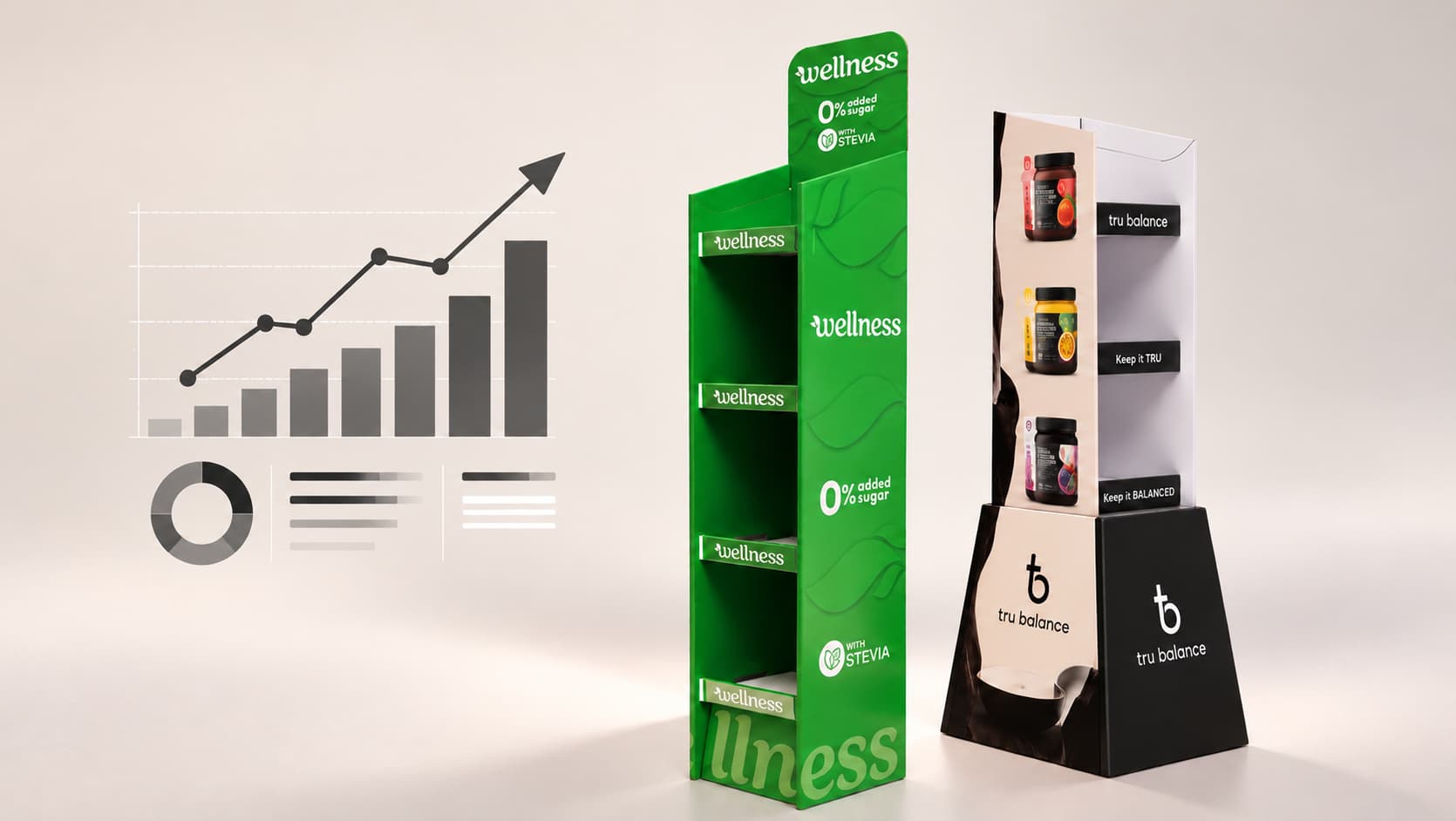
How many displays were produced? How many stores were they installed in? What happened to sales during the campaign? These are three different questions. The first indicates production volume, the second reflects actual execution across the retail network, and the third points to the marketing outcome.
This distinction is essential when POS materials are to be evaluated as an investment rather than simply as a production expense. For a POS project to be measurable, the purpose of the display, the environment in which it will be used and the indicators by which its performance will subsequently be evaluated must all be clearly defined before the design process begins. Measuring a POS investment does not start after the campaign ends. It starts with planning.
“We need an advertising display” is not a sufficient brief for a project expected to achieve a specific marketing result. It matters whether a new product needs to be brought beyond the standard retail shelf, whether an entire product range requires a dedicated space, whether the display is intended for a short-term promotional campaign or whether it needs to remain in the retail network for a longer period. If the POS solution will also be used in future activations, this must be considered from the development stage.
Different objectives lead to different requirements. When launching a new product, visibility may be the primary objective. For a larger product range, capacity and product organisation become more important. Long-term placement requires careful consideration of the material, load-bearing capacity, restocking process and the display’s performance under daily use. This is how the marketing objective is gradually translated into the language of design and structural engineering.
Within the extensive range of POS solutions offered by DIMEko, the dimensions, structure and display method are developed according to the specific product and project requirements. Before production begins, a prototype is always created to verify the structure, dimensions and required load-bearing capacity.
What does it mean for a POS campaign to be measurable? A measurable POS campaign has a predefined objective and a set of indicators through which its actual execution and performance can be evaluated. This does not necessarily require a complex KPI system. What matters most is that the selected indicators are directly connected to the campaign objective.
If the objective is to support sales, revenue or the number of units sold can be monitored. For campaigns implemented across a larger retail network, it is important to establish what proportion of the produced displays were actually installed in stores. If the POS material includes a QR code or another trackable digital element, interactions with it can provide additional information. For a reusable display, the number of campaigns or periods served by the same solution can also be measured.
Sales are important, but they do not tell the whole story. An increase in sales during a POS campaign is a significant indicator, but it does not prove on its own that the change resulted exclusively from the new display.
Other factors may also be at play during the same period, including promotional pricing, advertising support, seasonality, changes in demand or variations in product availability.
Results therefore have greater value when examined in context. Where the available data allows, periods before and during the activation can be compared, or stores featuring the specific POS display can be measured against an appropriate comparison group. Sales data can be supplemented with information about product availability, restocking and the actual placement of the display. The more useful question is: how did the campaign perform under the specific conditions, and what can we learn from its results?
Execution across the retail network should also be monitored: how many displays were actually installed, where they were located and whether the product presentation corresponded to the original concept. This information is particularly important when analysing performance. If results fall short of expectations, the reason may be insufficient product availability, unsuitable placement or incomplete campaign execution.
If a display is used in several consecutive activations, the investment logic differs from that of a POS solution created for a one-off promotion. This does not mean that a reusable display is always the better option. A short-term solution may be entirely appropriate for a particular campaign. What matters is that the expected lifecycle of the POS display forms part of the initial brief rather than becoming a question only after production.
The design must serve a specific purpose. “We want it to stand out” may sound logical, but it is not a sufficiently precise POS design brief. The more important question is what should be noticed first: the brand, the new product, the promotion, a particular product feature or the entire range. The answer influences the product arrangement, communication areas, advertising elements and the structure itself.
Functionality is also part of marketing performance. If packages obscure one another, product labels are not clearly visible, shelves are difficult to restock or access to the product is restricted, strong graphic design alone cannot compensate for these shortcomings.
The reverse is equally true. A structurally stable display that does not communicate the product and brand clearly fulfils only part of its marketing purpose. This is why the design, structure and display method must be treated as parts of a single POS solution.
Placement within the store also affects performance. Even the same POS display can serve a different purpose depending on where it is positioned. A standalone display in a high-traffic area, a structure placed directly beside its product category and a display located in a less frequently visited part of the store do not operate under the same conditions. This must be taken into account when analysing the results.
The final question should not simply be, “Was the campaign successful?” Specific conclusions are more valuable. Did the display have sufficient capacity? Was it easy to restock? Did it retain its functionality throughout the planned period? Was the format appropriate for the particular product category? Were there store locations in which the display performed better? Could the same structural concept be reused or adapted for a future activation?
By accumulating observations of this kind, the brand develops its own practical knowledge of its POS presence. This is where measurement begins to deliver its greatest value—not because it labels a completed campaign as either “successful” or “unsuccessful,” but because it reduces uncertainty when planning the next one.